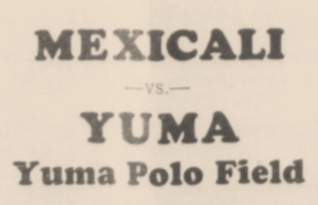
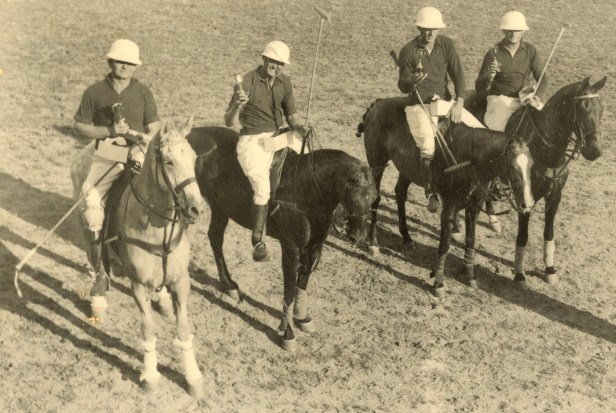
During the hard times of the Great Depression entertainment was as important as ever, and Yumans in the 1930s had many entertainment choices, including movies and concerts, dancing, baseball and softball, golf, swimming, and . . . polo. Yuma’s polo era lasted about 10 years, and the local version of the “sport of kings” was uniquely inclusive with widespread community support. With modest admission fees and a renowned local polo team, the Valley Polo Field attracted large, diverse crowds for its Sunday afternoon games.
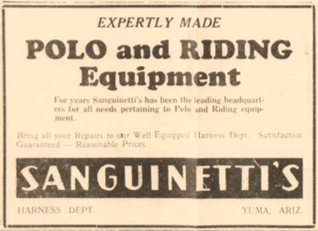
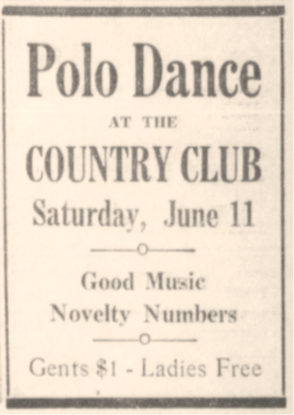
The improbable story of polo in Yuma begins with a man named James Walker who immigrated from Scotland as a teenager in 1903. By 1915 Walker was living in Wheaton, Illinois with his new wife Marie while operating a horse stable for J. Langford Stack, a millionaire advertising executive and father of future actor Robert Stack. J. Langford Stack had a passion for polo, and James Walker was a member of Stack’s Chicago polo team. Walker’s association with Stack was financially lucrative, and when Mr. Stack died in 1928, he reportedly left a substantial bequest to James Walker.
It is not clear what brought James and Marie Walker (and their three children) to Arizona, but in 1924, after residing briefly in Somerton and Sentinel, the couple purchased an acreage on 8th Street in Yuma. The property also became home to several polo ponies.
James Walker sought out local riders and ranchers who were interested in learning to play polo. Since there were many horsemen in the Yuma area, Walker quickly found eager learners, but it took time to for the “cowboy polo” of the local men—with their large, lumbering horses and heavy western saddles—to adapt to Walker’s style of fast, competitive polo. Two polo teams were formed in 1928, and both were coached by James Walker. The Yuma Valley team played on a field near Forman’s Store located at Avenue B and County 12½ Street. The McDaniel team had a field near the large McDaniel packing shed south of Somerton. E.M. McDaniel was a prominent vegetable grower and shipper, and the first McDaniel team was comprised of his four sons. (Later, a son-in-law was a member of the four-man team.) When the teams disbanded for the summer in 1928, it was announced that a Yuma polo club would be formed in the fall and that polo saddles and other equipment had been ordered from England.
In March 1929 the local newspaper reported that the “polo grounds” had been completed and that a game had been scheduled between the Yuma and Somerton teams. The polo field would undergo several improvements over the next few years, including the construction of stables, grandstand, clubhouse, and loudspeaker system, plus a racetrack which surrounded the regulation-size (300 x 160 yard) field.
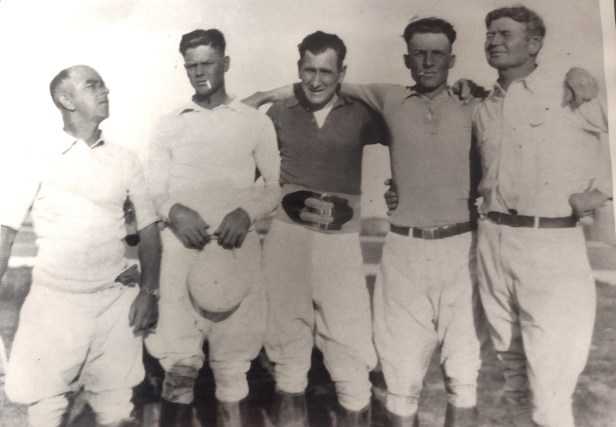
Polo not only requires special equipment and highly trained ponies; it is also a difficult sport to learn. For this reason there was a fairly small core group of players who dominated Yuma’s polo era. The early Yuma team typically consisted of James Walker, Yuma businessman Ed Brazeel, and Valley ranchers Tom Shawn and Sam Caruthers. Later teams included 16-year old Neil Collins and Yuma physician Chester Wilson. The Yuma Polo Club was also supported by several non-playing members, including Sam Dick, Marcel Forman, and Brady Collins. The Yuma Valley Polo Club was incorporated with stockholders and officers in October 1935.
Throughout the 1930s Yuma’s polo fields hosted numerous visiting teams who were always welcomed with Yuma hospitality, in addition to excellent playing conditions and worthy competition. And on many occasions the Yuma Polo Club generously loaned ponies to the opposing teams. (In polo, each of the team’s four players requires at least two ponies per game, so hauling ponies to long distance games and tournaments can be quite expensive.)
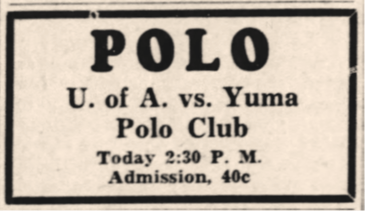

The University of Arizona polo team played several games—in Yuma and Tucson—versus the Yuma Valley team and the McDaniel team. The U. of A. program began in 1922 and achieved six Western Intercollegiate championships before being disbanded in 1942 due to the U.S. entry into World War II. It is remarkable that such an acclaimed university program would regularly schedule polo games with teams from Yuma—and even more remarkable that the games were often tightly contested. (In 1934 the university squad escaped with a 6-5 win after trailing for most of the game.)
The March 22, 1933 visit by the Riviera polo team created a stir in Yuma. Many Hollywood stars were members of the Riviera Polo Club, and it was speculated that Will Rogers or Robert Montgomery might be among the visiting players. Yuma’s downtown merchants agreed to close their businesses while the Wednesday afternoon game took place. Charles Farrell, a well-known actor at the time, was the most recognizable of the Riviera players who defeated Yuma 7-6.
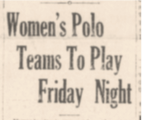

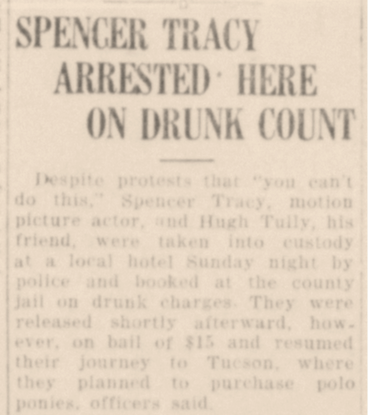
On November 30, 1934 a notable exhibition polo game was held, not at the Yuma polo field, but at Yuma High School’s Doan Field. The Pacific Coast Women’s Polo Association sent two of its teams on a barnstorming tour of the southwest that fall, and thanks to the sponsorship of the Yuma Polo Club, a game featuring the two women’s teams was held in Yuma. The high school football field was much smaller than a regulation polo field, but it was chosen so that more spectators could be accommodated. Polo historian Horace Laffaye later wrote of the Yuma game, “On a hard, fast field, the women played the best game of the tour.” One of the touring polo players was Louise Tracy, wife of famed actor Spencer Tracy. The Tracys had a troubled marriage, but they shared a love of polo and were active members of the Riviera Polo Club. On March 12, 1935, a few months after Louise’s Yuma visit, Spencer Tracy had a far different polo-related experience in Yuma. He was arrested on a “drunk count” at a local hotel where he had stopped off en route to Tucson where he would purchase polo ponies.
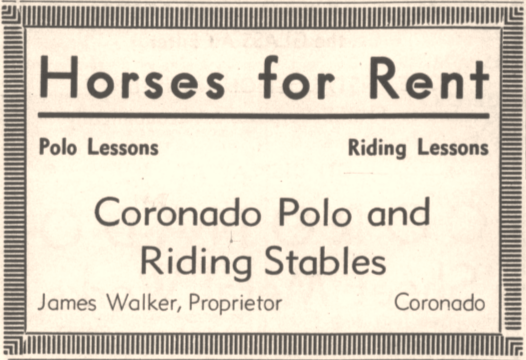
In late 1935 James and Marie Walker moved to Coronado, California where James operated the Coronado Polo and Riding Stables, while Marie served as a riding instructor for children. Tragically, in March 1941 Marie Walker died at the age of 45 from a fatal fall at the stables. James Walker died by suicide eight years later at the age of 64, a sad ending for a true ambassador of the sport of polo.

From the outset it was evident that the Yuma Valley Polo Field was going to be a multi-purpose site which would host a variety of community events in addition to polo games. These events included a shooting demonstration, a turkey shoot, midget auto races, FFA livestock shows, Campfire Girls campouts, horse racing, and even baseball. More significantly, from 1930-1943 the polo field was the home for an annual series of rodeos, first sponsored by the Elks and then the Eagles fraternal organizations. Horse shows, often preceded by horse parades, were also held at the polo field. By 1940 polo was absent from the polo field; consequently, promotions for events often mentioned the location as the “old polo field.” For the next few years, horse racing would be the venue’s signature event.



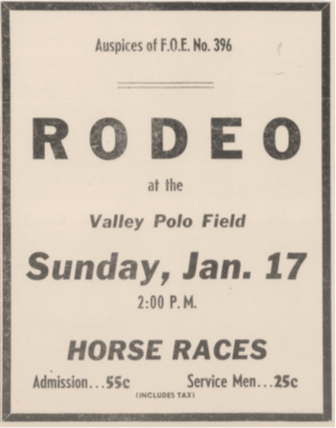

For several years the polo field had served as a de facto fairground for the community, and in January 1942 the Yuma Polo Club offered its 40-acre site to Yuma County for just that purpose. Initially, the Board of Supervisors voted to accept the donation. However, in March 1942 the supervisors reversed their decision, citing “the present war crisis,” as well as the property’s unpaid back taxes and outstanding water and construction bills.
In 1946 the Yuma Jaycees sponsored the first annual Silver Spur Rodeo. Seven years later, in 1953, the first annual Yuma County Fair was staged. These were milestone events for Yuma’s elected officials and community leaders—and for Yuma’s citizens who have continued to support these annual celebrations. The happenings at Yuma’s “old polo field” clearly laid the groundwork for the grander rodeos and fairs that came later. And, yes, Yuma really was once the “polo hotbed of the Southwest.”
 Yuma History Guy