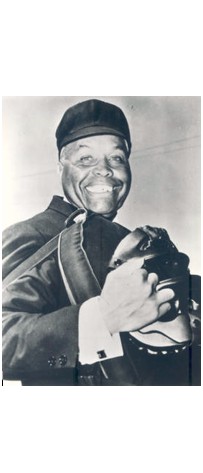
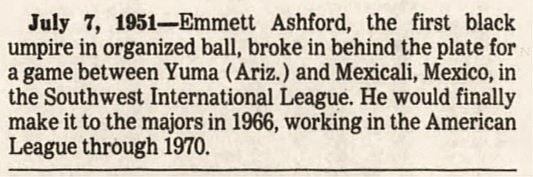
Emmett Ashford’s name is rarely mentioned in accounts of baseball’s long struggle to end segregation within the sport. Jackie Robinson has been rightly celebrated for breaking baseball’s “color line” as a ballplayer when he joined the Brooklyn Dodgers in 1947. And Frank Robinson is remembered for becoming the first black manager in the Major Leagues in 1974. Emmett Ashford deserves similar recognition for his pathbreaking career as organized baseball’s first black umpire. I will trace the highlights of Ashford’s impressive career and eventful life, including Yuma’s small but vital role in the story.
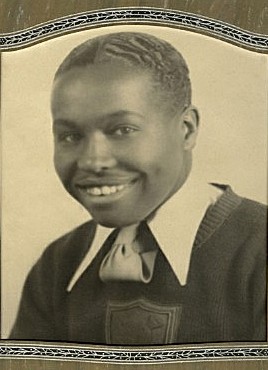
Emmett Ashford was born in Los Angeles in 1914, and was raised by a single mother who worked for the California Eagle, a black newspaper for which Emmett would later write a popular weekly column. He excelled in academics and eventually earned a degree from Chapman College. He was employed as a postal worker for 15 years, and first worked as an umpire at a game featuring a post office team.
Minor League pioneer, 1951-1965
When Emmett Ashford’s trailblazing career as a minor league umpire began in 1951 at age 35, he had already amassed a decade of umpiring experience, including college games for USC and UCLA, as well as National Softball Congress tournament games in Phoenix. Prior to joining organized baseball Ashford also completed three years of military service with the U.S. Navy.
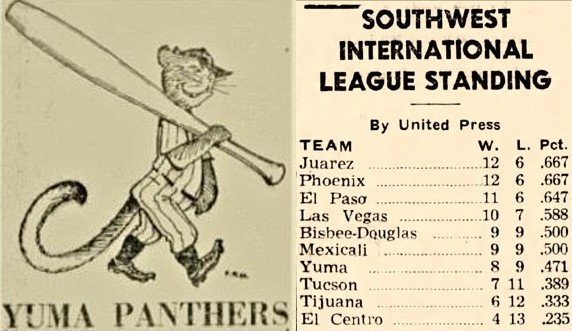
The Yuma Panthers (1950-1952) were Yuma’s first minor league baseball team. The standings listed above were published following the conclusion of the four-game series between Mexicali and Yuma which featured Emmett Ashford breaking a long-standing “color line” by working as the first black umpire in organized baseball (i.e. non-Negro League professional baseball). The league president Les Powers was familiar with Emmett Ashford’s umpiring experience with West Coast college teams, and he offered Ashford a tryout opportunity in Mexicali. The umpire requested a leave of absence from his post office job–which he would leave permanently at the end of the 1951 season. His success and popularity in the Southwest International league convinced Ashford to make umpiring his full-time vocation, but his new career got off to a rocky start in Mexicali as he later recounted:
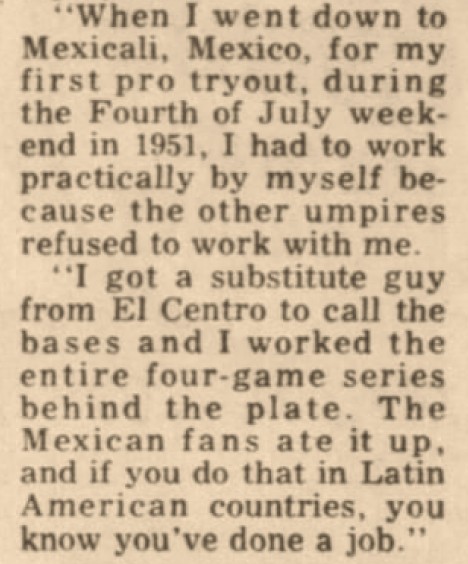
At first the SWI league avoided assigning Emmett Ashford to games in El Paso out of concerns over potential racial incidents. When he later worked games there he was gratified by the positive fan response. However, throughout much of his umpiring career Ashford had to deal with segregation off the field even when he was being treated with respect and adulation on the field. He often had to arrive at host cities before his fellow (white) umpires in order to make his lodging and dining arrangements.
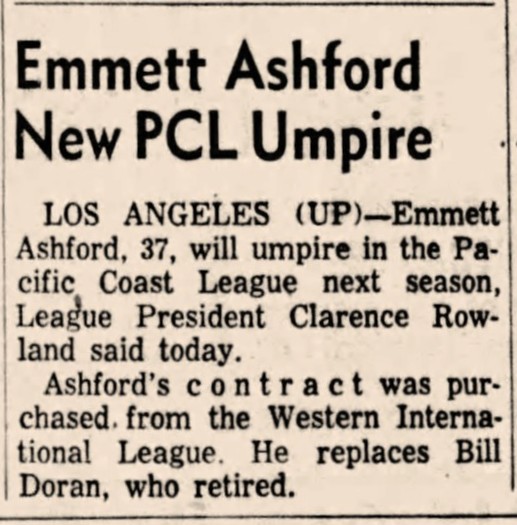
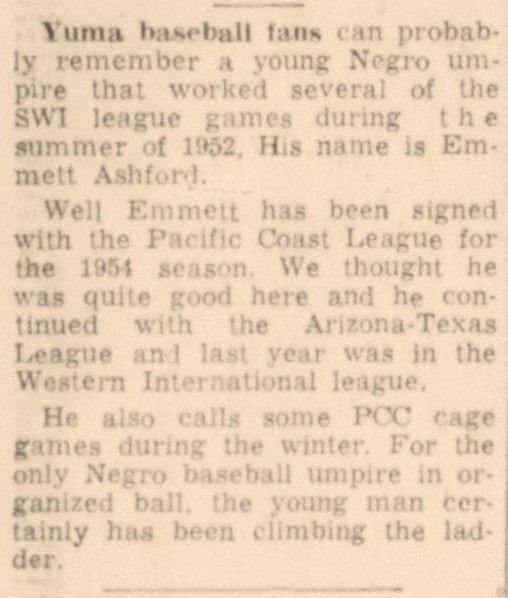
When Emmett Ashford was signed as a Pacific Coast League umpire for 1954, the Yuma sports editor fondly remembered Ashford working Yuma Panthers’ games in 1951 and 1952. The column noted, “For the only Negro baseball umpire in organized ball, the young man certainly has been climbing the ladder.” For the next dozen years Emmett Ashford would often be touted as a worthy candidate for the Major Leagues, but his climb up the ladder would remained stalled as his legend grew in the Pacific Coast League. As a young man Emmett loved to dance. He and first wife Willa Gene were members of a group called the Rugcutter’s Club. Daughter Adrienne Bratton later noted the dancing influence on Emmett Ashford’s umpiring style: “He had a unique style. He’s been described as dancing around the plate. He was agile and light on his feet. His colorful style incorporated extra physicality and animation. He made his voice resound like thunder. He was a fantastic showman and a snappy dresser. He put fans in the stands.”
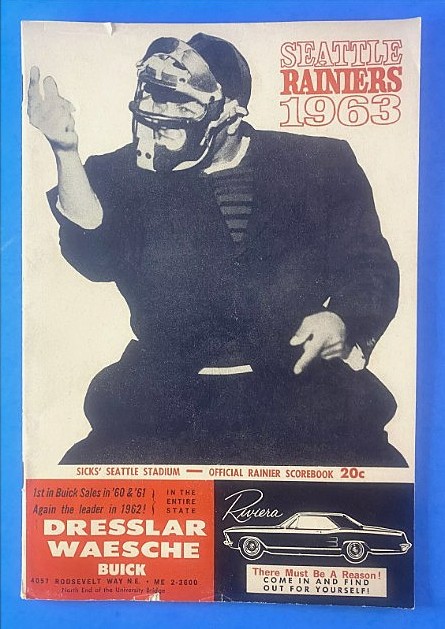
Since Emmett Ashford was better known than most of the players in the Pacific Coast League, his image was used on league publications such as this Seattle Rainiers scorebook. Ashford, who was promoted to the position of PCL umpire-in-chief in 1963, would not only sign autographs for fans; he travelled with a typewriter so he could answer his fan mail.
Major League pioneer, 1966-1970
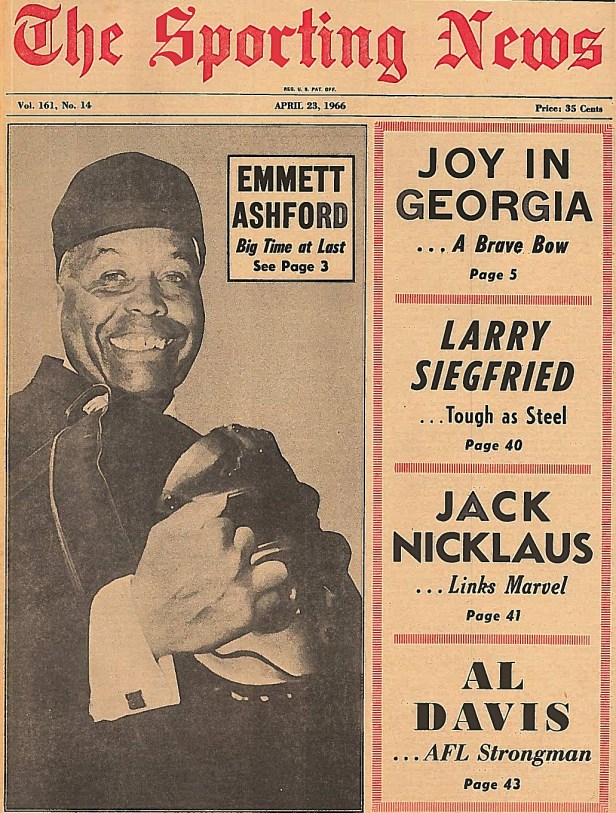
The caption above speaks volumes: “Big Time at Last.” Emmett Ashford was 51 years old when he finally got called up to work as a Major League umpire–the first black man to achieve that distinction. Due to baseball’s mandatory retirement age for umpires, Ashford’s Major League career lasted only five years.
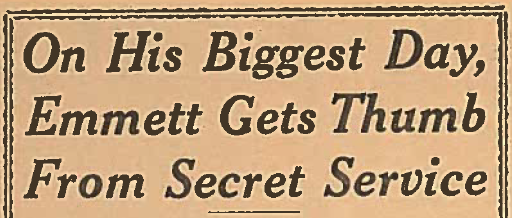
Emmett Ashford’s first game as a Major League umpire was the April 9, 1966 opening day contest between the Washington Senators and Cleveland Indians. There was a heavy Secret Service presence at the Washington, D.C. ballpark due to Vice President Hubert Humphrey’s appearance to throw out the ceremonial first pitch. Emmett Ashford was initially prevented from entering the ballpark by Secret Service agents who did not believe that a black man was a Major League umpire–an unfortunate indignity for Emmett Ashford on his “biggest day.” But Ashford made baseball history that day as he worked a flawless game as the third base umpire, and following the game he was able to meet Vice President Humphrey.
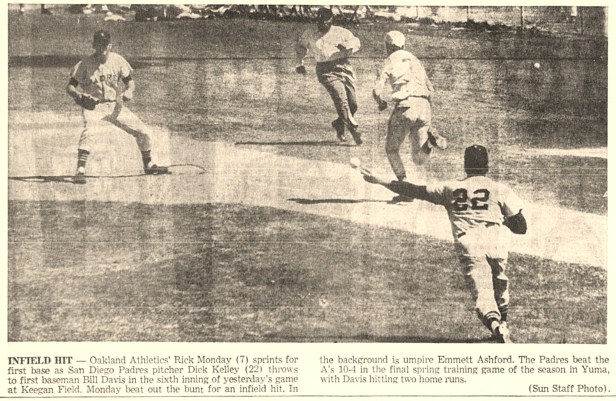
In 1969 the San Diego Padres held their first season of spring training at Yuma’s Keegan Field. Emmett Ashford was an American League umpire but was part of the crew for the above interleague game between the Padres and the Oakland Athletics. He can be seen here running down the foul line to get a better view of a close play at first base. When he worked in the field as a base umpire, Ashford would often break into a sprint to get closer to the action–a strategy resented by some of his more stationary colleagues.
Highlights of Emmett Ashford’s Major League career include being selected to work the 1967 All Star game and the 1970 World Series. When he became a Major League umpire, Ashford tried to tone down the flamboyant style he was known for in the Pacific Coast League, but he retained his distinctive approach. He explained, “I never had a chance to go to umpire school, so I evolved my own style out here. And, of course, it was frowned upon.” Retired umpire Jim Honochick expressed a typical complaint against Ashford’s style: “You can’t be a good showman and a good umpire.” Nonetheless, there were many more Emmett Ashford supporters who appreciated the joy that he brought to a seemingly dull profession.
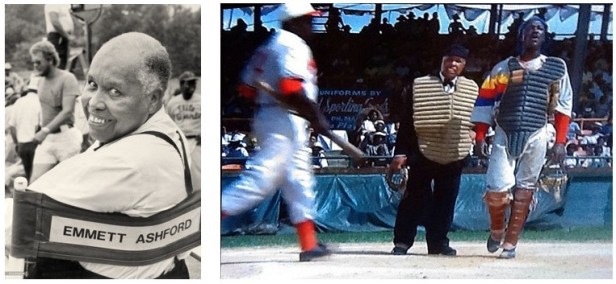
Emmett Ashford’s supporters and detractors would have agreed that he was a natural entertainer who would have no trouble playing a Hollywood version of an umpire. “The Bingo Long Traveling All-Stars and Motor Kings” was a lighthearted look at the nomadic adventures of an early barnstorming black baseball team. Ashford had a supporting role in the film which starred Billy Dee Williams, James Earl Jones and Richard Pryor.
Keeping Emmett Ashford’s legacy alive
On March 1, 1980 Emmett Ashford died at age 65 from a heart attack. Since retiring as a Major League umpire following the 1970 season Ashford had been working as a special assistant to baseball commissioner Bowie Kuhn who offered a touching eulogy at Ashford’s funeral: “As the first black umpire in the major leagues his magnanimous nature was sternly tested. But he was unshaken and uncomplaining, remaining the colorful, lovely personality he was all his life.”
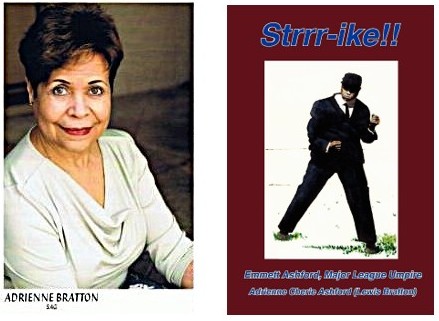
In 2004 Adrienne Bratton, one of Emmett Ashford’s two daughters, published a brief biography of her father. The book reflected her pride in her father’s groundbreaking career in professional baseball, but it also revealed some painful memories of her parents’ divorce and the lengthy loss of contact with her father that followed:
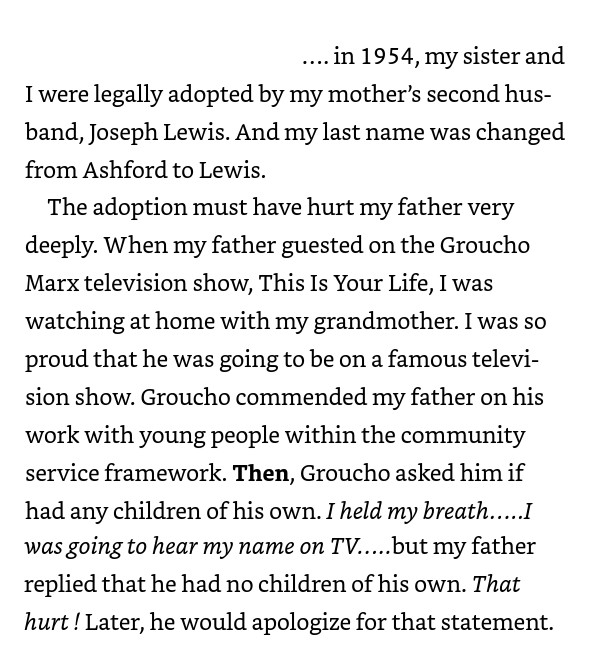
Adrienne initiated a happy reunion with her father in the last decade of his life. She also became the biggest advocate for Emmett Ashford’s election to the National Baseball Hall of Fame–an honor which has not yet been granted.
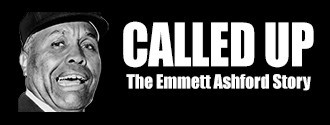
A documentary film titled “Called Up: The Emmett Ashford Story” has been in production for several years. It is slated for future airing on PBS, and it is my hope that the film will create renewed interest and appreciation of Emmett Ashford’s legacy. The film may also generate support for Ashford’s long overdue election to baseball’s Hall of Fame.
 Yuma History Guy