
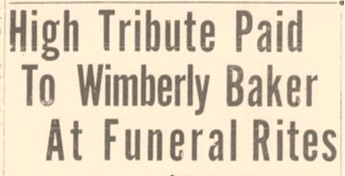
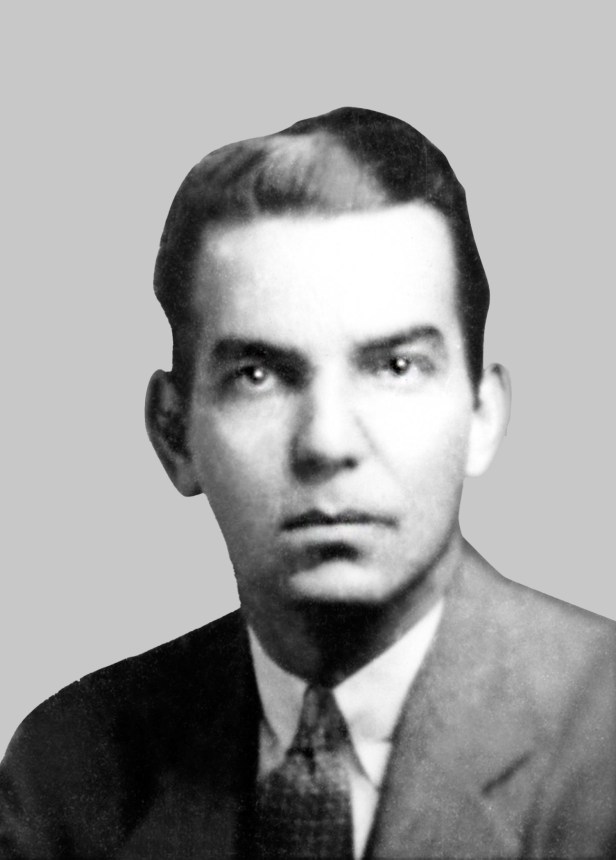
The April 21, 1937 funeral service for 27-year-old Wimberly Baker was reported to be “the largest ever held in Yuma County.” Hundreds gathered to remember Yuma’s fallen FBI agent who had been killed days earlier in a Topeka, Kansas shootout with two fugitive bank robbers. Wimberly Baker is remembered on the FBI Wall of Honor as the 9th FBI agent to die in the line of duty. In addition, the FBI’s Kansas City field office honors Baker’s sacrifice with its Wimberly W. Baker Conference Room. Yuma, too, should not forget this local hero who managed in his short lifetime to make positive contributions in many endeavors.
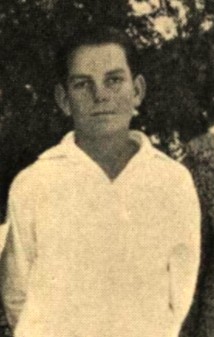
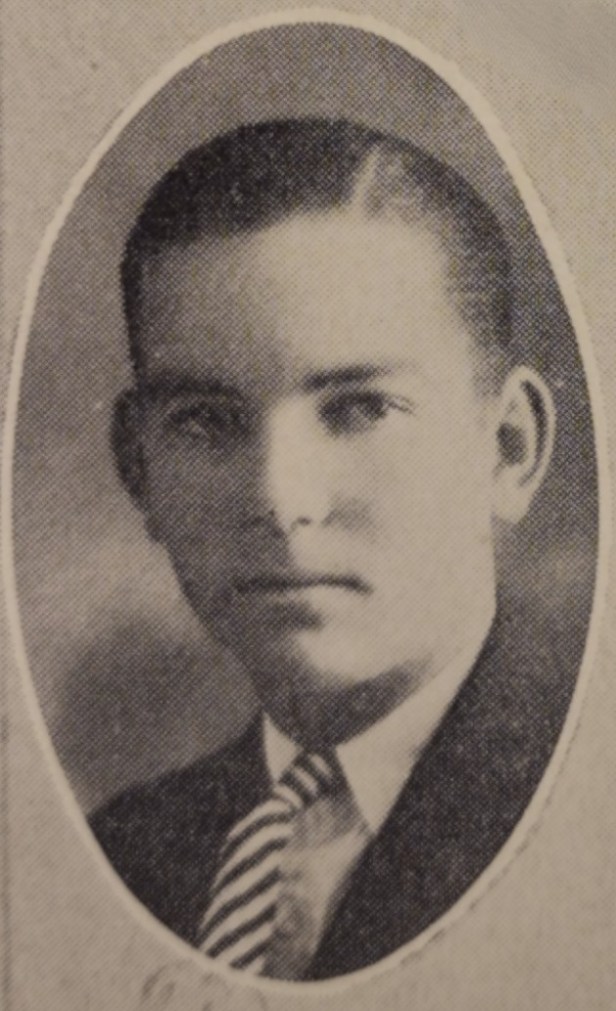
Wimberly Wayne Baker was born January 10, 1910 in Joppa, Illinois. His parents, Hosea Henry Baker and Ruby Sexton Baker, moved to Yuma in 1912. H.H. Baker taught school in Gadsden before becoming a Yuma attorney. He later served as Yuma County Attorney and was eventually elected to the Arizona state senate for four terms. Ruby Baker worked for a time as a probation officer and in later years was active in “welfare work.” The remaining two members of the Baker family were born in Yuma: Bill Brown Baker in 1920 and Betty Bly Baker in 1922.
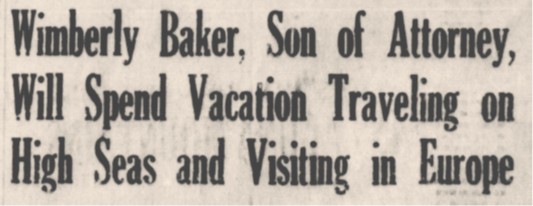
The headline mentioning 16-year-old Wimberly Baker’s “vacation” is misleading. This determined young man did wish to visit Europe following his freshman year of high school, but he would do so as a “deck boy” on a steamship which sailed from San Francisco to New York through the Panama Canal, and then across the Atlantic Ocean. To obtain the required Seaman’s Certificate, Wimberly enlisted the aid of U.S. Senator Ralph Cameron.
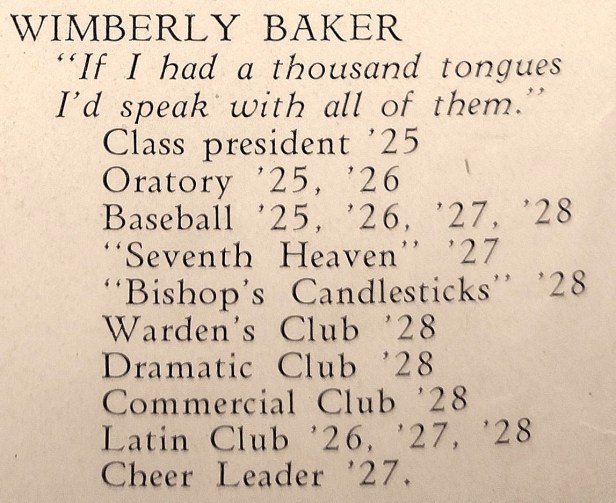
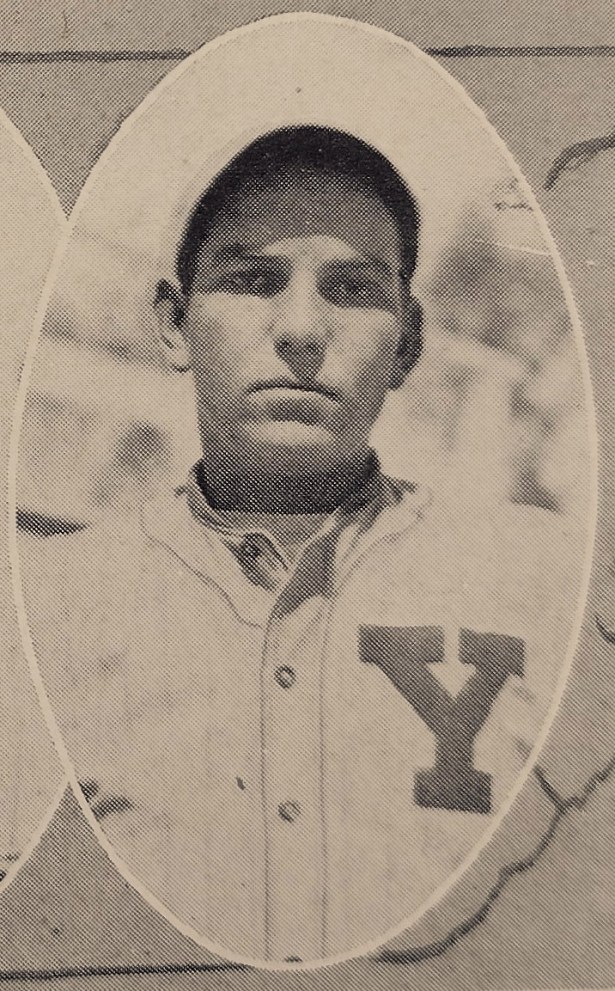

Wimberly Baker loved baseball, and it is no surprise that he ended up as a catcher, the most demanding position on a baseball team. His Yuma High School teammates gave him the nickname “Wam.” Baker also played on the baseball team at the University of Arizona, where he was often the battery mate of future Major League all-star Hank Leiber, who pitched for the Wildcats but played outfield as a professional.
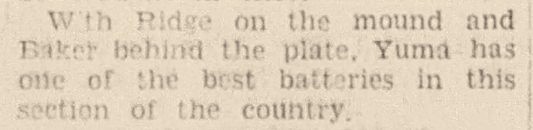
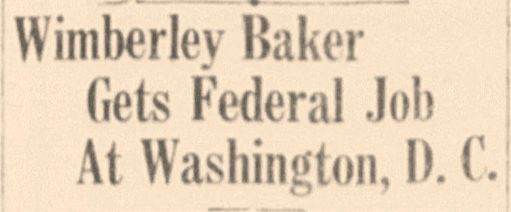
The above newspaper excerpt praises the pitcher-catcher battery of Yuma’s town team, the Cubs. Jimmie Ridge was a longtime local pitching ace, and Wimberly Baker was his regular catcher. But Baker’s baseball days were coming to an end. After two years at the University of Arizona, Baker had returned to Yuma to begin a law enforcement career as a deputy sheriff. The next step in that career took him to Washington, D.C. in October 1933 where he held a clerical job with the Department of Justice while attending law school.
FBI Special Agent
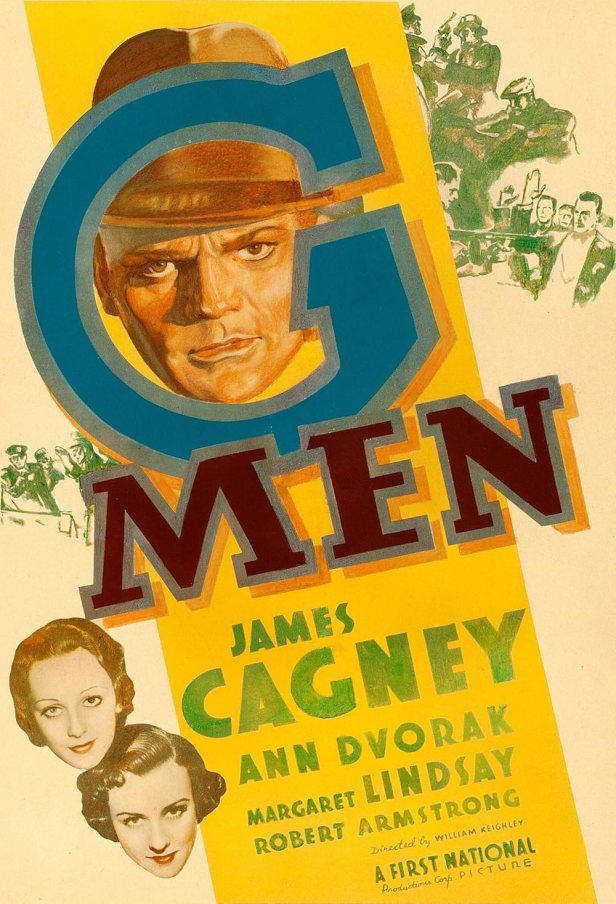

After earning his law degree in 1936, Wimberly Baker was accepted into the newly established FBI National Academy. He became an FBI Special Agent on January 16, 1937. Baker joined the FBI at a time when public approval of the agency’s “G-men” [government men] was at its zenith. FBI director J. Edgar Hoover helped cultivate a heroic public image of himself and his agents by giving his personal input and approval to print publications and Hollywood films such as those pictured above.
Fugitive bank robbers
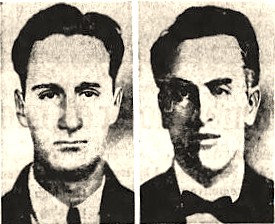

Special Agent Baker was assigned to the Kansas City field office, and his first case involved the surveillance of the Topeka, Kansas post office where he and two other agents were seeking fugitive New York bank robbers Robert Suhay, 26, and Glen Applegate, 45. The men, who had become acquaintances in prison, were both out on parole when, on March 12, 1937, they robbed a bank in Katonah, New York of $18,000 and fled westward in a stolen car. The FBI was tipped off that the men were receiving mail at the Topeka post office general delivery counter, and on the third day of an FBI stakeout, agent Wimberly Baker approached Glen Applegate to make an arrest after receiving a confirmation signal from a postal worker. Robert Suhay reacted to Baker’s movements by firing multiple gunshots, striking Baker in the back and chest. A gun battle broke out in the Post Office lobby in which over a dozen shots were fired. There were many bystanders present, two of whom suffered non-life-threatening injuries. Suhay was shot in the wrist as he and Applegate retreated from the bank. Wimberly Baker’s grave injuries led to his death several hours later after emergency surgery and blood transfusions failed to save his life.

Topeka’s “Old Federal Building,” the site of the deadly shooting, housed a Post Office on the first floor and a U.S. District Courtroom on the third floor–the same courtroom where in 1951 the momentous Brown v. Board of Education case was litigated prior to being heard by the U.S. Supreme Court.
Escape and capture
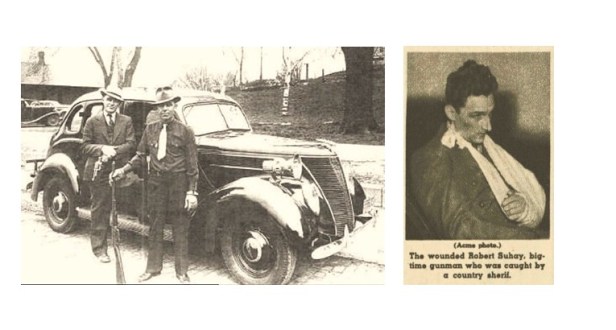
Shortly after escaping from the Topeka post office, the fugitives wrecked their automobile and flagged down Joe Garver, a farmer from nearby Sabetha, Kansas. Garver drove the men to his home, where they ordered him to summon the town doctor, S.M. Hibbard, to come and treat Suhey’s gunshot wound. After Dr. Hibbard treated the injury, the criminals stole his car and headed north toward Omaha.
Law enforcement officials in the area were quickly alerted with details of the stolen vehicle and were provided with descriptions of Suhey and Applegate. Late that evening in the town of Plattsmouth, Nebraska–roughly 150 miles north of Topeka–Sheriff Homer Sylvester and his deputy, brother Cass Sylvester, spotted the stolen car and began following the fugitives into the town of Plattsmouth. Fittingly, the men drove down a dead end street. Realizing that they had no way to escape, the criminals got out of their automobile and surrendered without resistance.
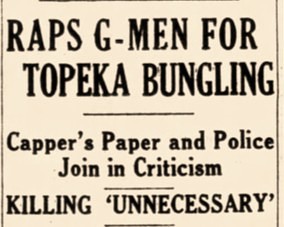

Sheriff Sylvester became an instant folk hero as the “country sheriff” who captured the fugitive killers without firing a shot. In contrast, the FBI came under criticism from some local newspapers and law enforcement officials for the handling of the post office stakeout. Topeka chief of police Frank Stone stated, “I cannot understand why the federal men didn’t ask our cooperation. It could have been accomplished easily and without needless waste of life. Baker certainly would have been alive today had this been done.” FBI director Hoover defended his agency against the attacks, and Dwight Bradley of the FBI Kansas City division noted the parole status of the killers: “Another parole board made a mistake for which Agent Baker paid with his life.”
Trial and execution
The trial of Robert Suhay and Glen Applegate began on June 21, 1937 and was completed in five days. Sixty witnesses testified for the prosecution while the defense called no witnesses. The jury deliberated for only two hours before finding both defendants guilty of murdering Wimberly Baker. On May 31, 1938 the U.S. Supreme Court affirmed the lower court’s verdict by denying an appeal from Suhay and Applegate.


In the early morning of August 12, 1938 Robert Suhay and Glen Applegate were executed by hanging at the federal prison in Leavenworth, Kansas. Since the murder victim was a federal officer, the convicted men were punished with federal executions. The father and the 18-year-old brother of Wimberly Baker were among the witnesses. H.H. Baker issued a statement that reflected both his background as an attorney and his heavy loss as a father: “I am satisfied the law has taken its course. The men got what they needed. I appreciate the efforts of all who aided in bringing them to justice. They killed a mighty fine boy for no reason at all.”
Postscript — More Baker family tragedies

Wimberly Baker’s mother, Ruby Sexton Baker, died at age 46 on June 7, 1932. At the time of his mother’s death, Wimberly was 22 years old, while younger brother Bill was 11, and sister Betty was 10. A coroner’s inquest found that “death was accidental due to ill health.” The newspaper article explained that Ruby Baker “apparently took by accident a small quantity of poison, thinking it was medicine.”

On February 10, 1944 Bill Brown Baker died at age 23 in an airplane crash into the Mississippi River near Memphis, Tennessee. He was an ensign in the U.S. Naval Reserve and was returning to duty after a brief visit with his father in Yuma. As the headline mentions, Bill Baker was the son of Arizona state senator H.H. Baker. Sister Betty’s marriage to Joseph Halloran, Jr. had taken place three months earlier.
Like his older brother Wimberly, Bill was active and successful at Yuma High School, serving as senior class vice president, and as a contributing member of the school newspaper and yearbook staffs. He continued his studies at the University of Arizona, where he graduated from the law school with honors in May 1943.
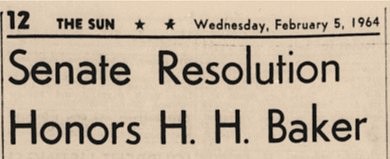

Hosea Henry Baker died at age 84 on December 8, 1963 in Prescott, Arizona, where he had moved following his 1950 retirement. H.H. Baker’s obituary highlighted his political background and noted that he was a veteran of the Spanish American War. The obituary listed only two survivors: his brother Fred and his daughter Betty.
Betty Bly Halloran died on August 2, 1997 at age 75. She was survived by her husband, retired Army 1st Lieutenant Joseph Halloran, and the couple’s two daughters and one son. Betty’s brother Bill Brown Baker had died 53 years earlier. Her death came 60 years after that of her eldest brother, Wimberly Baker.
 Yuma History Guy