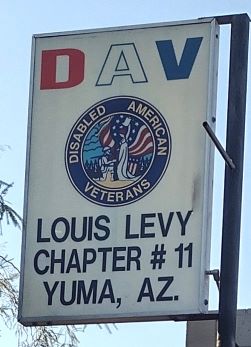
Yuma’s Louis Levy Chapter #11 of the Disabled American Veterans is tucked away in a quiet neighborhood on 13th Avenue. The veterans and their families who are served by this facility may know the background of the man for whom it is named. But for those who do not know about Louis Levy—and his brother Harry Levy—here’s my tribute to these two men who contributed to their community and who valiantly served their country in World War II.
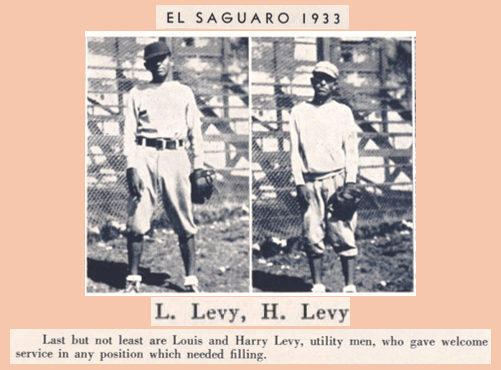
The 1933 Yuma High School yearbook includes a rare acknowledgment of two “utility men” on the baseball team—brothers Louis and Harry Levy. Louis (class of ’33) and Harry (class of ’34) may not have been star high school athletes, but they remained active in local baseball and softball for several years after graduation. The Levy brothers’ names appeared often in the sports pages of the Yuma Sun during the 1930s, and it was while compiling articles and box scores of early Yuma baseball and softball games that I first became aware of their involvement with numerous Yuma teams and leagues.
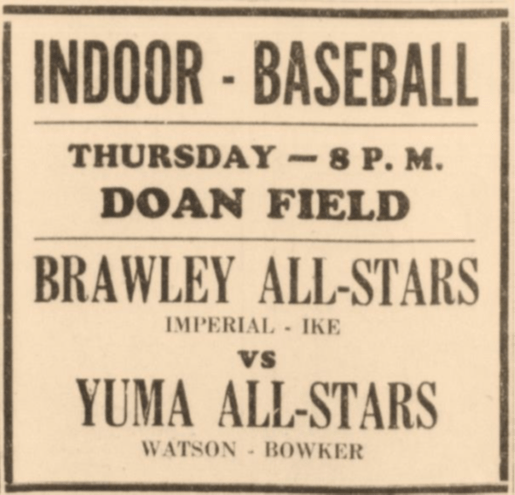
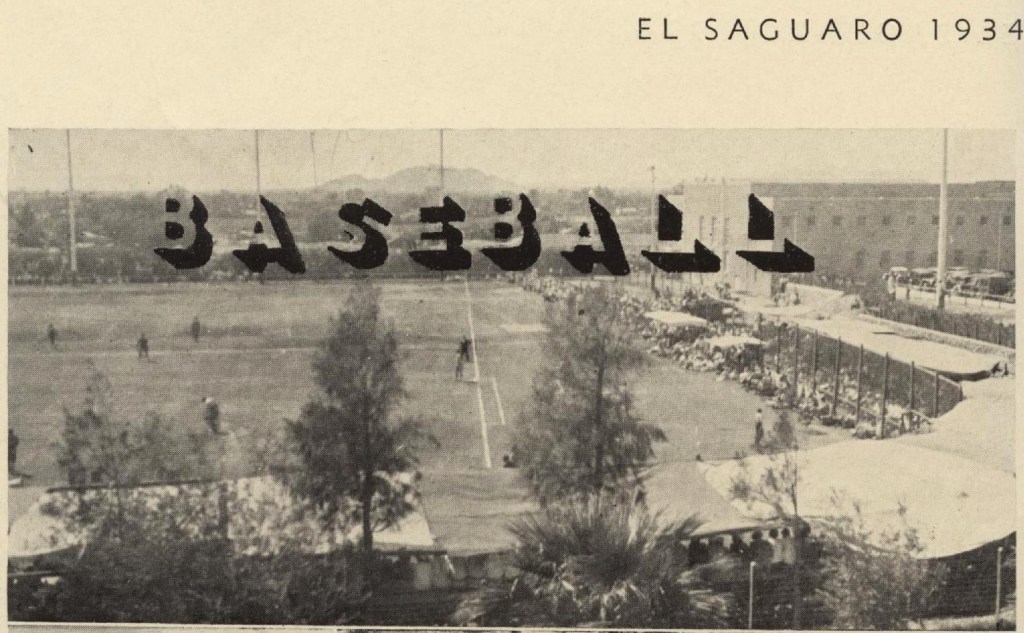
Softball was becoming popular in Yuma around the time Louis and Harry graduated from Yuma High—popular in terms of both participants and spectators. Teams were sponsored by local businesses, churches, and even government agencies like the Bureau of Reclamation. Games held at the high school’s Doan Field sometimes drew over 2,000 fans. However, until about 1935, softball was usually not called “softball.” The sport was reportedly invented in 1887 when an old boxing glove was used as a ball and a broomstick was used as a bat. The equipment quickly evolved, but since the new game had been first played indoors, it was commonly referred to as “indoor baseball”—even when played outdoors!
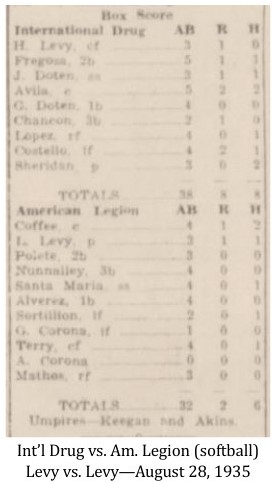
Louis and Harry Levy could play any infield or outfield position, and Louis sometimes pitched for his softball teams. Over the years they played for many teams: Alpha Steam Laundry, American Legion, Bureau of Reclamation, Independents, International Drug, Jack and Kelly, Knights of Columbus, Mexican All Stars, Milk Fund, Yuma All Stars, Yuma Cubs, Yuma Nighthawks . . . and more! Local leagues sometimes had rules prohibiting teams from “borrowing” players, but these rules could be relaxed if a team didn’t have enough players to suit up for a game. This may have been the case when Louis and Harry played on opposing teams on August 28, 1935. On that rare occasion, Harry played center field for the International Drug team while Louis pitched for the American Legion squad.
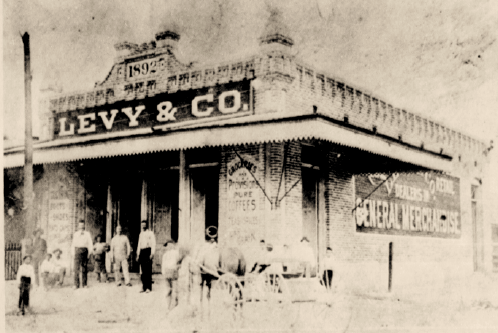
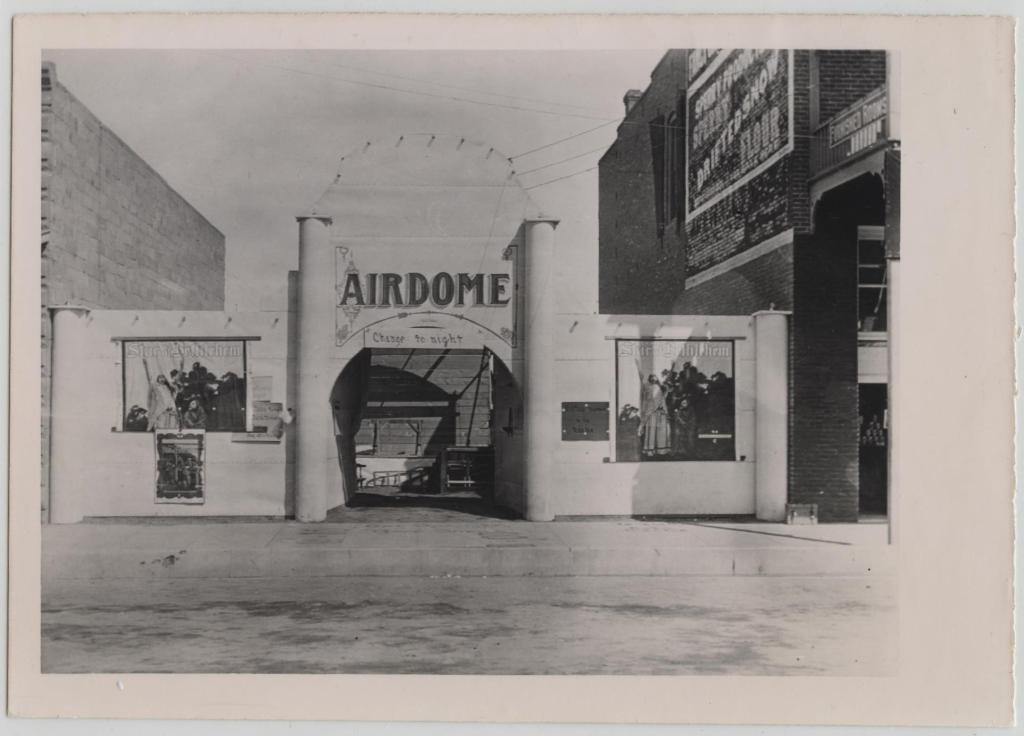
Louis Levy and Gloria Downey both came from pioneer Yuma families. Louis’ grandfather Isaac was an early merchant, while Gloria’s grandparents built the famed Wilson House which functioned as Yuma’s first hospital, and later served as a boarding house and hotel. Gloria’s father, George Downey, was the chair of the County Board of Supervisors at the time of his death. Louis’ father, Louis Levy, Sr., was the manager of an early outdoor Yuma theater called the Airdome. He later worked as bookkeeper of Harry Brownstetter’s clothing store. The elder Levy was a victim of the influenza pandemic of 1918. He contracted the illness and died the following year at age 37. Louis, Jr. was four years old when his father died, and Harry was three.
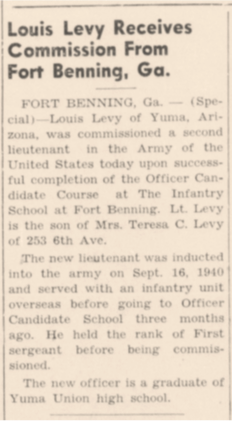
Gloria Downey, like Louis Levy, attended Yuma High School, but the two were not classmates due to Louis being six years older than Gloria. On October 25, 1941 Sgt. Louis Levy, on furlough from Camp Barkeley in Abilene, Texas, returned to Yuma to marry Gloria Downey at Immaculate Conception Church with brother Harry serving as best man. A few hours later the couple boarded a train bound for Abilene. By Mother’s Day 1942 Louis was stationed in the Panama Canal Zone where he and several other Arizona Army men were able to send special radio greetings to their mothers. In early 1943 Louis Levy completed Officer Candidate School in Fort Benning, Georgia, and in February 1944 he was promoted to the rank of first lieutenant.
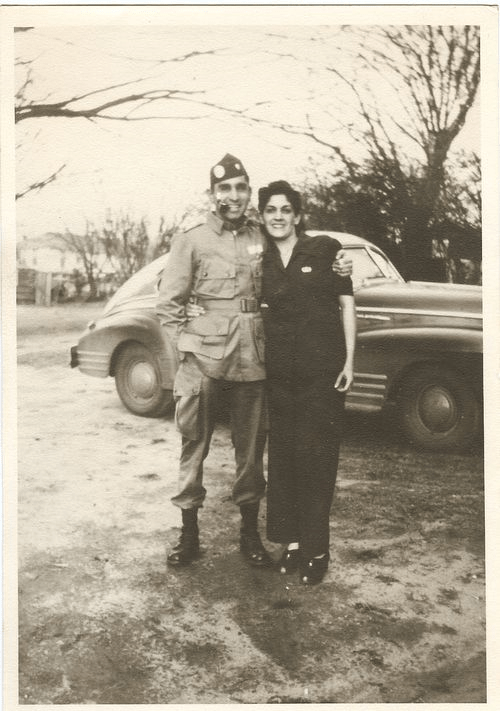
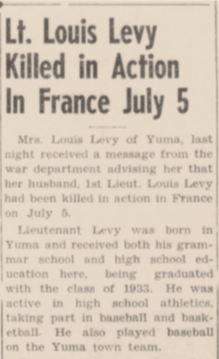
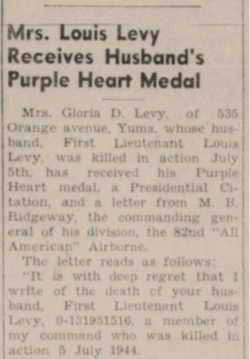
Louis and Gloria’s brief marriage came to a tragic end when Louis died in battle on July 5, 1944. His death occurred in the Battle of Normandy a month after the D-Day invasion by the Allied forces. First Lieutenant Louis Levy served in the U.S. Army 507th Parachute Infantry Regiment. He was 29 years old.
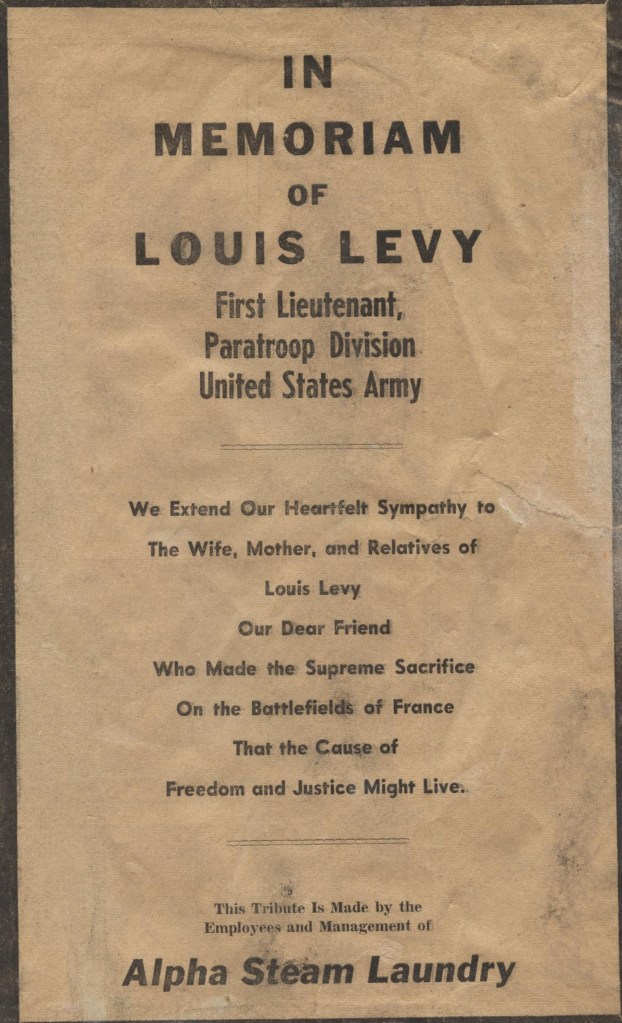
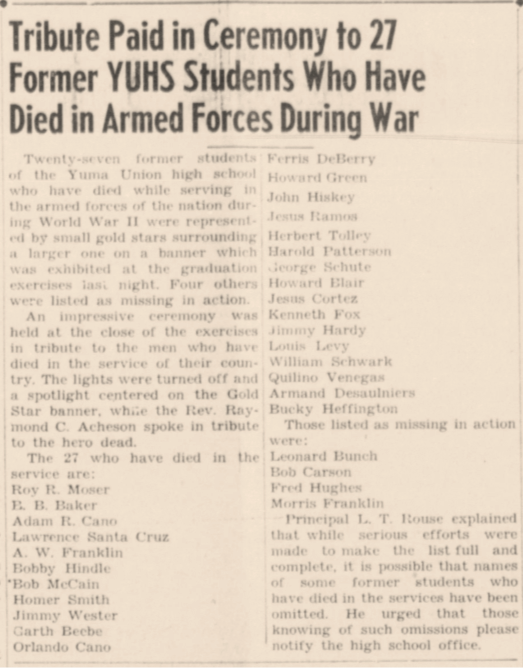
Louis Levy had been an employee of the Alpha Steam Laundry, and he had frequently played on their softball team. In response to the sad news of Louis’ death, a full-page tribute from the Alpha staff was printed in the Yuma newspaper. The following year, at the May 31, 1945 graduation ceremony of Yuma High School, a memorial observance recognized 27 former students who perished in the war, as well as 4 others listed as missing.
In 1946 Gloria Levy married J.T. Hodges, Jr., but ten years later she was once again a widow—this time with several young children to support. Gloria moved to Pensacola, Florida in 1962 where she resided until her death in 2000 at the age of 79. She was survived by her (third) husband of 32 years, Arthur Grebe. Her obituary noted that she was also survived by nine children.
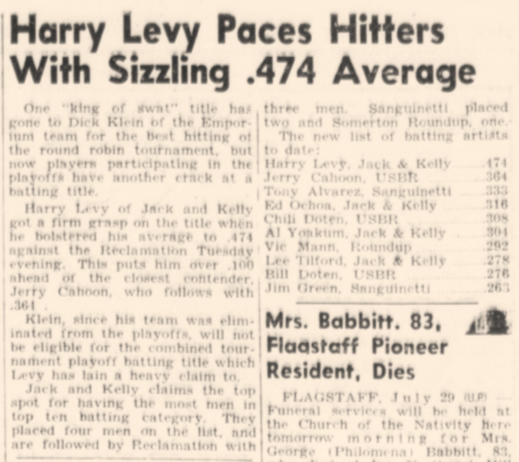
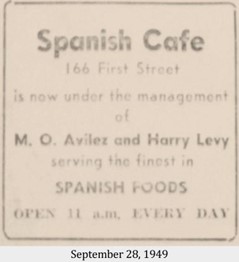
After the war, Harry Levy stayed active in local baseball and softball. In the summer of 1948 Harry was much more than a “utility player” for the Jack and Kelly softball team; he was the top hitter in the entire softball league. Within a couple of years, however, Harry’s name was no longer appearing in local baseball and softball box scores. Harry and his wife Lydia began operating the Spanish Café at the time of the above announcement, and that responsibility may have prevented him from continuing his ball playing. (Previously, Harry had worked for the Southern Pacific Railroad.)
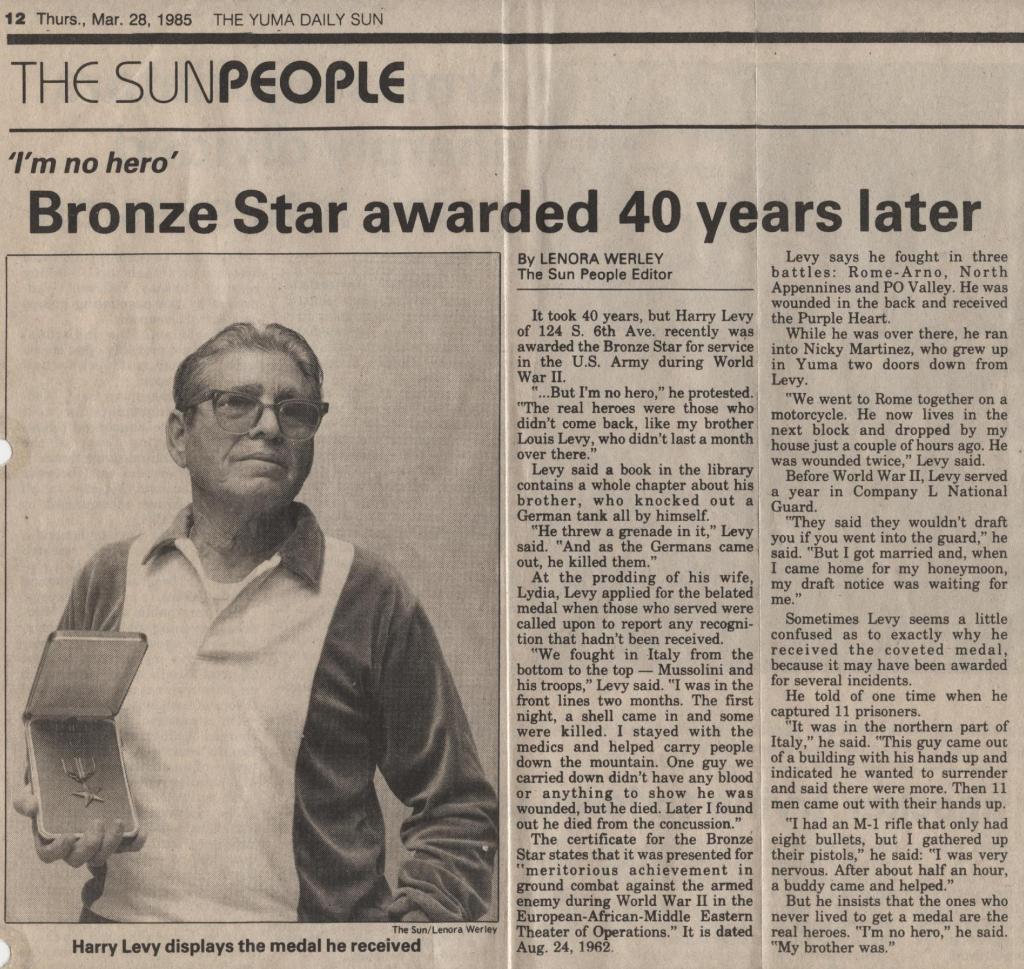
Like brother Louis, Harry joined the Arizona National Guard before being inducted into the Army. Harry did not become an officer like Louis, but he saw combat in World War II as an Army private in Italy. In March 1985 Harry Levy was belatedly awarded a Bronze Star for his heroism. In a newspaper interview, Harry Levy, at age 69, remained humble about his wartime experiences, saying, “The real heroes were those who didn’t come back, like my brother. I’m no hero. My brother was.”
Harry Levy died on January 5, 2006—three weeks shy of his 90th birthday. He was survived by his wife of 65 years, Lydia Abril Levy, and their son Gallagher. While the Levy brothers’ military service and sacrifice was obviously more important than their athletic accomplishments, baseball clearly played a big part in Louis and Harry’s lives. This love of baseball is illustrated in a comment from Harry Levy in a 1985 oral history interview. When asked if he’d had part-time jobs while in school, Harry responded, “I delivered papers on Main Street for a while. But I used to stop and watch them play baseball, so I was late and got fired.”
 Yuma History Guy
A well written and inspiring story!
LikeLike
Jim has done hours of research for the YHS Athletic Hall of Fame- looking up records, news articles, pictures- information the HOF committee needed to mke decisions on those being nominated for induction into HOF. Without his help, we would not have the info required to consider for induction. And now he’s turned his inquisitive research skills into developing articles for his blog! Long live history and those who pass on the rich stories of the past. Gay Thrower
LikeLike